Background
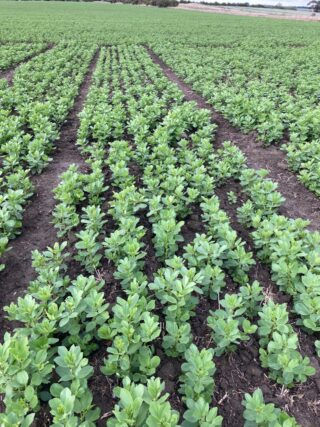
Levels of disease, particularly the wet weather disease Chocolate spot (Botrytis fabae) were extreme in 2022 with a number of crops completely defoliated by the disease. Poor spraying conditions preventing timely spraying combined with high leaf moisture and humidity created the perfect storm for disease infection. Whilst better fungicide strategies and more resistant varieties retained some potential, yields were sharply down in many paddocks around the country compared to the record of 2021.
Despite this extreme disease pressure in 2022, faba beans still have the potential to fulfil important fertility and a break crop role in HRZ farming systems, particularly where markets are more readily available for the grain.
Prevalent diseases
Over the last decade the most prevalent disease has been Chocolate spot caused by the pathogen Botrytis fabae. This disease is particularly prevalent after crop canopy closure, in line with an increase in humidity (quoted as >70%). The disease has a temperature range of approximately 15 – 28°C with more rapid spread with warmer temperature within this range. Infection can occur on many parts of the plant including flowers, leaves, stems and pods. When planning a disease control strategy be aware of higher risk scenarios such as variety susceptibility; for example, PBA Bendoc is particularly susceptible or proximity to badly infected stubbles from the season before.
Since 2020 we have seen increasing levels of bean rust in our research caused by the pathogen Uromyces vicia-fabae. This has been particularly prevalent in the second half of the season in green leaf tissue that has not been affected by Chocolate spot. What has been noticeable in our development work is that, whilst SDHIs give good control of Chocolate spot, it is not a given that they give good control of bean rust.
Download the full document by clicking on the READ MORE tab.