|
Issue 5_inGRAINed Cropping Strategies
Disease Management in Wheat (2024)
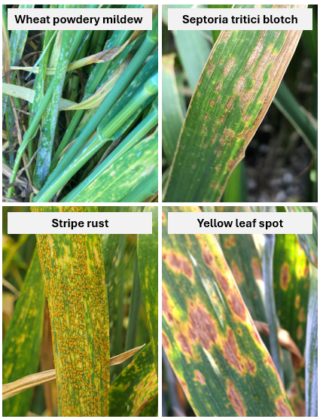 | | | |
Product choice for later season fungicide timings GS39 – 61 Issue 5 of ‘InGRAINed’ follows the release of issue 4 a couple of weeks ago and addresses flag leaf sprays and their importance in disease management strategies for wheat.
Key points Flag leaf spray applications (GS39) - Typically, in the medium – high rainfall zones (M-HRZ), in seasons with good yield potential, the flag leaf spray will be the most important fungicide application for a wheat crop as it protects the two most important leaves for grain fill (flag and flag-1).
- In springs where conditions turn dry during stem elongation (GS30 – 39), dry weather itself becomes an effective fungicide and is a key component to preventing upper canopy infection.
- Unfortunately, it not only reduces disease pressure (lower canopy humidity) and fungicide yield response, but often yield potential as well.
- This spring, monitor the crop intensively for disease between GS31 – 32 (first and second node) and flag leaf emergence (flag leaf emerged on the main stem). This should be approximately four weeks.
- If it’s more than four weeks, you may be spraying your first fungicide too early and therefore may require an additional fungicide to protect flag-2 and flag-3 before flag leaf, particularly when the stem elongation period is wet.
- If the period is dry with very few 5mm rainfall events, then consider lower rate options, or if only rust is the threat with no sign of Septoria tritici blotch (STB), then you may not need more expensive chemistry or higher label rates.
- Most importantly, be sure you know what you are spraying for. This is particularly pertinent in WA wheat crops where stripe rust and STB have not been an issue (see 2023 FAR Fungicide Fingerprinting yield results where the yield response in VIC, SA and WA are compared in disease susceptible varieties https://faraustralia.com.au/resource.)
- Remember GS39 is when the flag leaf has emerged on the main stem, not when the flag has emerged on all stems; when conditions are wet and disease conducive, this is important to recognise since the delay in waiting for all the flag leaves to emerge increases disease pressure on flag-1.
Download the full document by clicking on the READ MORE tab.
|