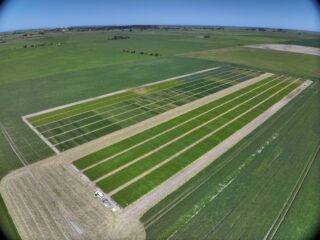
Objectives:
To assess the performance of three winter wheat varieties (red feeds) and one long season spring
cultivar of wheat (white) under three different fungicide management levels sown in mid-May in the
Millicent (SA) HRZ environment.
Sown: 11 May 2023
Harvested: 14 January 2024
Rotation position: 2022 Canola
Soil type & management: Organosol over grey clay
Key Points:
- There was a significant interaction between cultivar and fungicide management with cultivars responding differently to the number of fungicide units applied.
- Yields ranged from 7.34t/ha in untreated RGT Cesario, to 10.16t/ha in the newly released AGF cultivar Longford with full fungicide protection.
- Stockade (white wheat – APW) was the only cultivar to give no significant response in yield to fungicide application, although there was a trend for higher yield under full protection.
- Red wheats Longford, RGT Cesario and AGTW005 gave significantly higher yields with full protection based on 4 units of fungicide, but only RGT Cesario gave a significant response when a single fungicide was applied at GS39 (8.21t/ha vs. untreated 7.34t/ha).
- The yield response to full protection over untreated was Stockade (0.29t/ha), Longford
(0.63t/ha), RGT Cesario (2.12t/ha) and AGTW005 (0.64t/ha).
- The dominant diseases were stripe rust in RGT Cesario and Septoria tritici blotch (STB) in Stockade, although drier spring conditions reduced upper canopy infection with this disease.
- There was no obvious disease in Longford and only traces of Wirrega blotch and stripe rust inAGTW005 during grain fill.
- Longford and AGTW005 retained their green leaf the longest, but 4 fungicide units were
necessary to retain green leaf in RGT Cesario.
- Grain quality parameters varied slightly with the different combinations of fungicide and
cultivar, but all treatments had protein at 11% or over with slightly higher test weights under more intense fungicide management.
To access the full harvest yield results’ document, click on the READ MORE tab below.